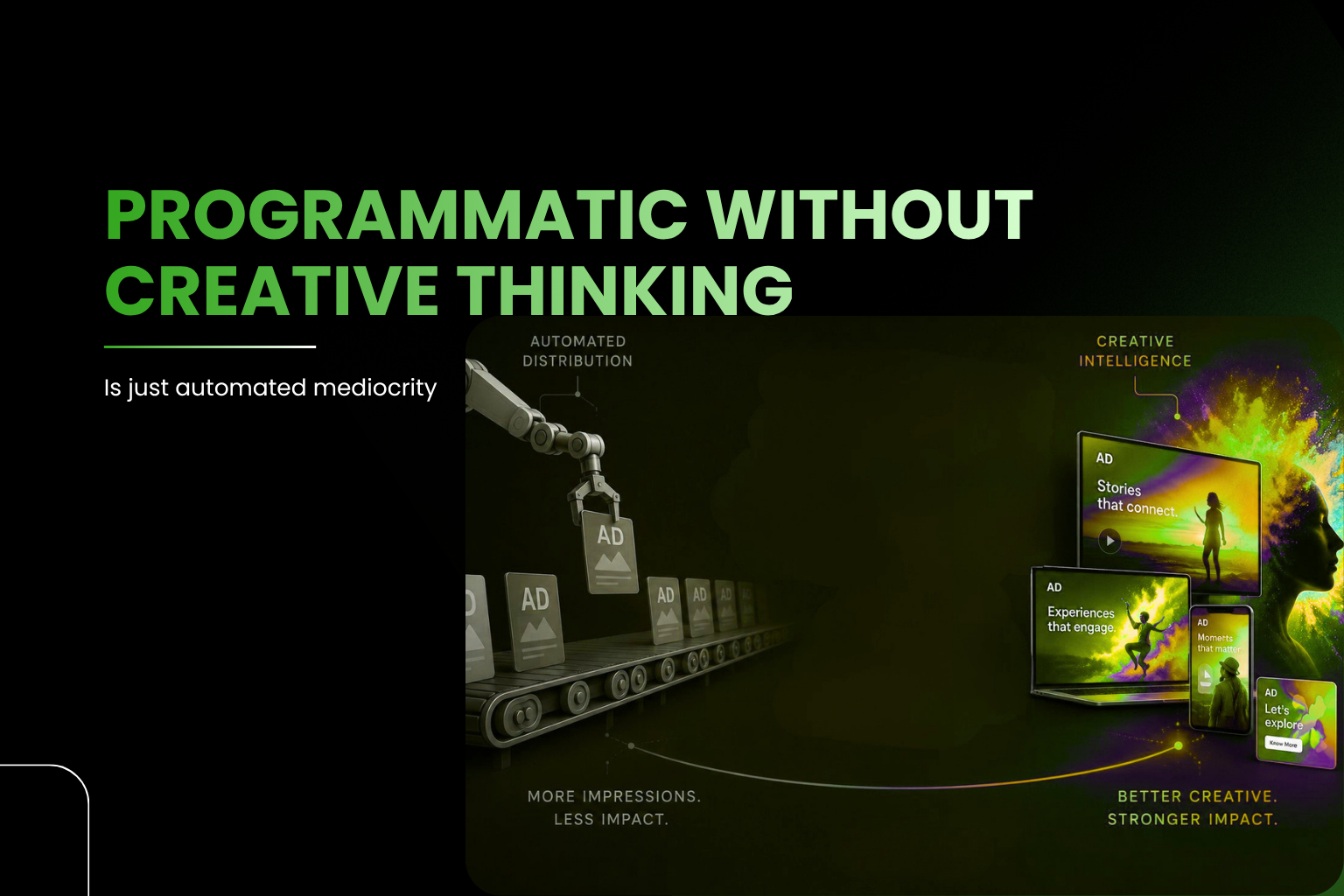
Programmatic advertising has made media buying smarter, faster and more precise.
But precision doesn't guarantee impact.
You can reach the right audience, on the right screen, at the right moment and still deliver a forgettable ad.
Because programmatic can automate distribution. It can't automate relevance.
The efficiency trap
Programmatic has transformed how brands buy media. Algorithms can identify audiences, optimise bids and shift budgets in real time.
But when the creative remains static, the intelligence stops at the media layer.
Why should someone seeing an ad for the first time get the same message as someone who has already engaged with the brand?
Why should a viewer on Connected TV experience the same creative as someone scrolling on mobile?
The opportunity is no longer just to buy impressions more efficiently. It's to make those impressions more meaningful.
Creative needs to become responsive
The old model separated media and creative.
Media decided who, where and when.
Creative decided what to say.
That separation is becoming outdated.
Today, audience behaviour, context, platform and moment can all influence how a brand should communicate. Programmatic gives us the signals. Creative intelligence gives us a way to act on them.
Instead of one master asset everywhere, brands can build creative systems that adapt to different audiences and contexts, while staying anchored to one strong brand idea.
That's not about creating endless variations.
It's about creating the right variation for the right reason.
AI should improve decisions, not just increase output
AI can generate more creative, faster.
But more creative isn't automatically better creative.
The real opportunity is using intelligence to understand which messages earn attention, which formats drive interaction, where audiences drop off and what creative actually moves people closer to action.
That's where AI moves from being a production tool to becoming a creative decision-making engine.
The next layer of optimisation is attention
Impressions, reach and clicks still matter. But they don't tell us whether an audience actually cared.
A campaign can deliver millions of impressions and still leave little behind.
The next generation of advertising will increasingly focus on what happens inside the impression:
Did someone notice? Did they engage? Did they remember? Did the experience move them?
This becomes even more important on Connected TV, where brands have the canvas to turn passive viewing into meaningful experiences.
Media intelligence × Creative intelligence
The future isn't programmatic versus creative.
It's programmatic with creative intelligence.
Media intelligence finds the opportunity.
Creative intelligence determines how the brand should show up.
And when the two work together, advertising becomes more relevant, more responsive and more memorable.
Because the goal isn't to automate advertising.
It's to make every automated impression count.
Automation can scale a bad idea.
Creative thinking is what makes it worth scaling.

