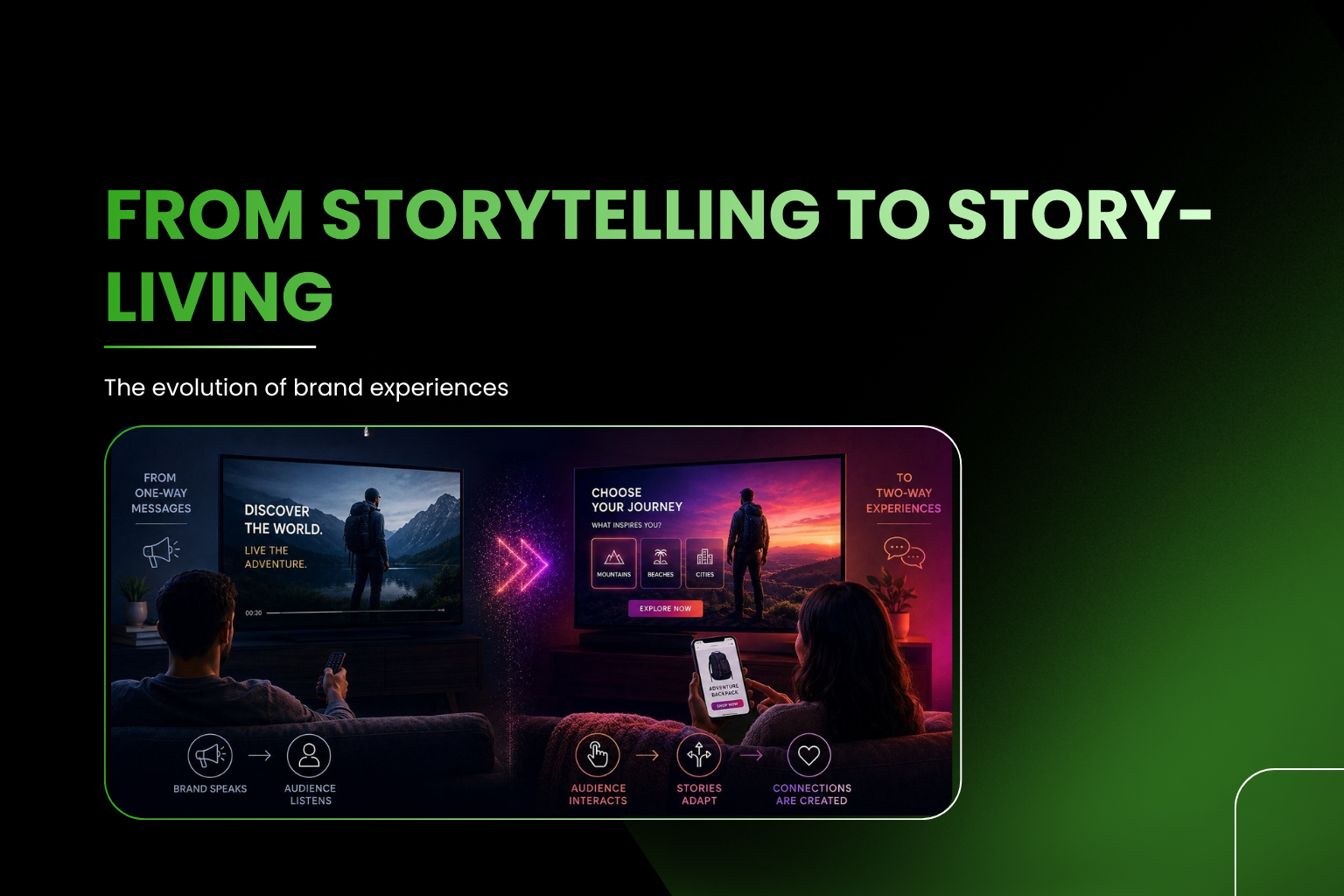
A brand used to have one job: tell a good story.
Build the narrative. Create the campaign. Put it on a screen. Reach as many people as possible.
But audiences have changed and so has the role of advertising.
Today, people don't just want to hear what a brand has to say. They want to experience it, interact with it, shape it, and sometimes even become part of it.
That's the shift from storytelling to story-living.
The End of the One-Way Brand Story
Traditional advertising was built around a simple model: the brand speaks, the audience listens.
A TV commercial created awareness. A digital ad drove a click. A billboard built recall.
The audience remained largely passive.
Today, consumers move across screens and formats without thinking about the boundaries between them. They discover, react, search, share, participate and purchase within the same journey.
So the question is no longer just, "What should the brand say?"
It is, "What can the audience do with the story?"
From Attention to Participation
Attention is harder to earn than ever. But simply being seen isn't enough.
There is a difference between someone watching an ad and someone choosing to interact with it.
That is where interactive advertising changes the game.
On Connected TV, for example, a brand experience can move beyond the traditional 30-second spot. A viewer can explore a product, discover more information or take the next step, turning a moment of viewing into a moment of participation.
The ad doesn't have to be the end of the story. It can be the beginning.
The Future Is Experience-Led
The brands that stand out won't necessarily be the ones that tell the loudest stories.
They'll be the ones that create experiences people want to be part of.
At Huella, we see this as the next evolution of advertising: moving brands from passive communication to active participation, across screens and throughout the consumer journey.
Because storytelling tells people what a brand stands for.
Story-living gives them a chance to experience it.

